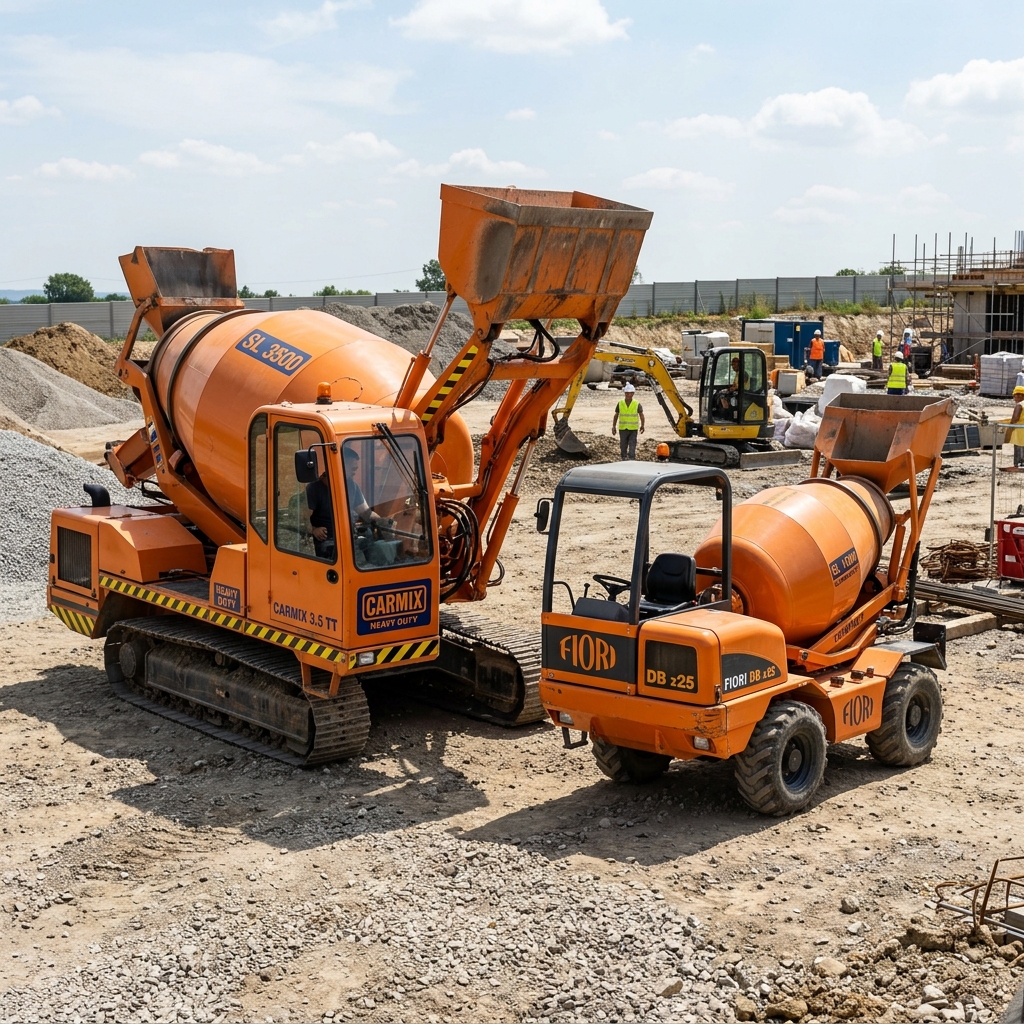
Selecting the correct concrete machinery is critical to the financial and operational success of any civil engineering project. For contractors in Gujarat, the choice often comes down to two highly versatile self-loading mixer models: the Ajax Fiori Argo 2000 and the flagship Ajax Fiori Argo 4000.
Understanding the Capacity Difference
The primary distinguishing factor between these two machines is their batch capacity and drum volume:
- Argo 2000: Features a drum output capacity of 2.0 cubic meters per batch, delivering up to 8 m³ of mixed concrete per hour.
- Argo 4000: Features a drum output capacity of 4.0 cubic meters per batch, delivering up to 16 m³ of mixed concrete per hour.
For large-volume foundations, columns pouring, and industrial flooring projects, the Argo 4000 is almost always required to maintain continuous concrete flow and prevent cold joints.
Site Access and Maneuverability
While the Argo 4000 boasts double the concrete output, it also has a larger footprint. On projects like irrigation canal beds, narrow residential lanes, or hilly road projects, tight turns and limited access points can make operating a larger machine difficult.
The Argo 2000 is specifically designed for tighter access sites. With its compact chassis and 3-mode steering (front wheel, crab, and coordinated steer), it can navigate tight residential developments in cities like Patan or Mehsana where larger transit mixers cannot enter.
Fuel Efficiency and Rental Budget
From a cost perspective, renting the Argo 2000 requires a lower monthly budget and consumes less diesel. However, if your pouring volume is high, the Argo 4000 becomes more cost-effective per cubic meter of concrete produced because it halves the batch cycle time, reducing overall labor hours.
Recommendation: Choose the Argo 2000 for residential foundations, narrow canal linings, and city projects. Choose the Argo 4000 for highway bridges, factory structures, and heavy ready-mix requirements.